
Appendix B : Notes on Civic Silence
Orwell writes from the grave...

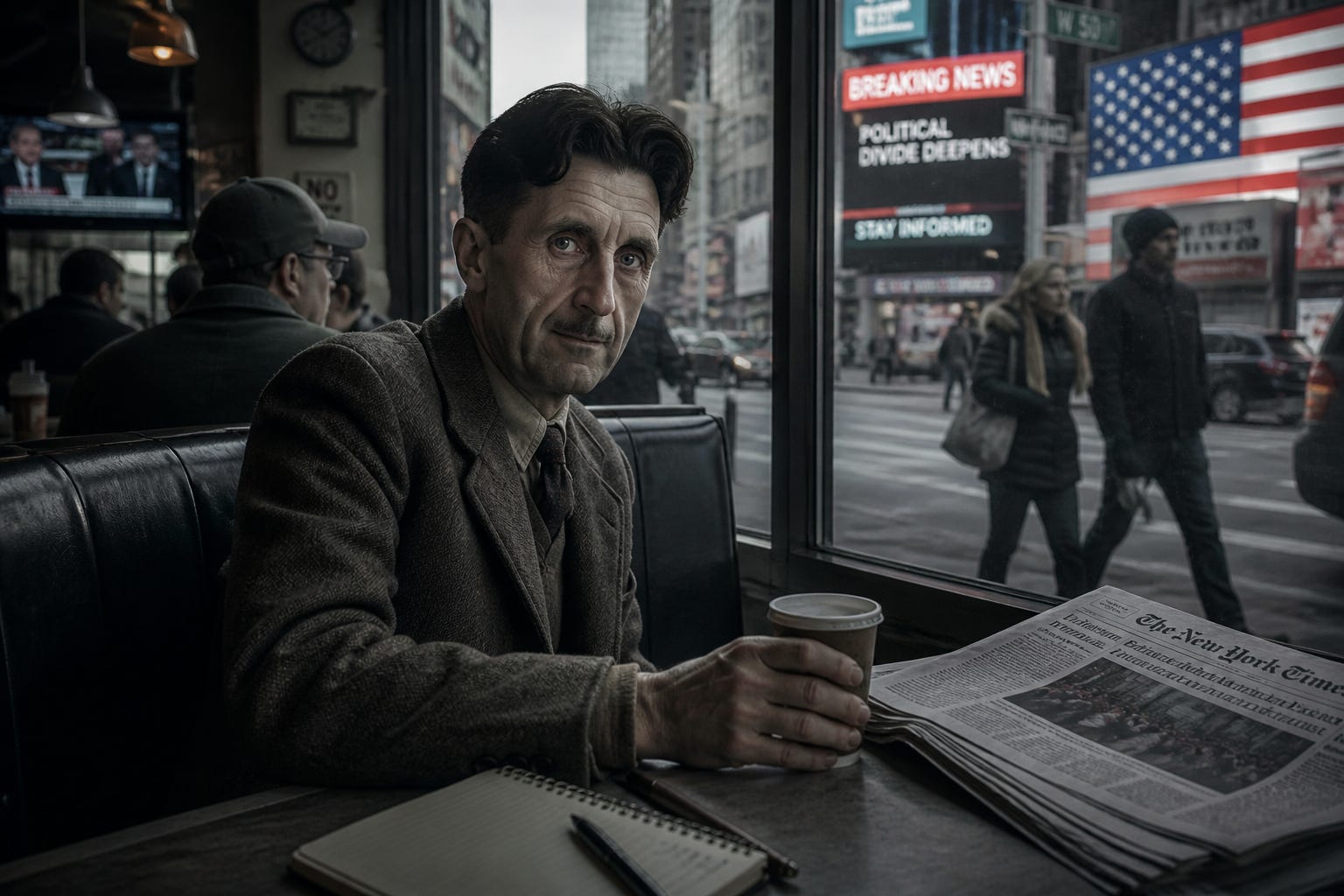
By The Big Wild Mind Machine
There was a period, not recorded in the bulletins, when the conversations stopped.
Not abruptly. That would have been noticeable, and therefore undesirable. It happened the way dust gathers on a surface that is no longer touched. One day a man would mention a thing he had read, and another would answer. The next day the answer would be shorter. The day after that, there would be a nod where a sentence had been. In time, even the nod acquired a quality of excess, and was retired.
In the canteens and small eating places, the tables remained occupied. Cups were lifted, set down, lifted again. The ordinary motions continued with a precision that suggested practice rather than habit. What had been removed was not speech itself, but a certain category of speech, one that had once been regarded as necessary to the maintenance of the self.
No prohibition had been issued. There were no posters instructing citizens to desist. On the contrary, the loudspeakers continued to invite participation in the usual manner. The effect was achieved by other means, more elegant in their operation.
The announcements multiplied. Each day brought new urgencies, each urgency accompanied by its own vocabulary, its own set of facts, and its own conclusion, which was required to be held firmly until the next announcement rendered it provisional. The citizen was expected to attend to all of it. To fail to attend was negligence; to attend fully was exhaustion.
In this way, the mind was not forbidden to speak. It was simply occupied.
A man sitting opposite another in a small place would sometimes begin to form a question. It would rise in him with the familiar shape, the old impulse toward exchange. But before it could be spoken, it encountered a crowd of other unfinished questions, each clamoring for its own resolution. The effort required to choose among them, to assemble the necessary fragments of knowledge, and to defend the result against contradiction, was calculated, if not consciously then by some deeper faculty, to exceed the available reserves.
The question was therefore set aside.
This setting aside, repeated over days and weeks, acquired the force of a custom. It was not that the citizens believed less. It was that belief had become labor, and labor had already been assigned in excess.
Those who continued to speak did so in specialized forms. They produced statements, analyses, summaries of events in which the contradictions were arranged in orderly fashion and the uncertainties given names. These productions circulated, but they did not easily cross the threshold into ordinary conversation. To introduce them at a table, uninvited, was to impose a burden on those who had already learned, without instruction, to avoid such burdens.
Thus a curious equilibrium was established.
The proclamations grew louder. The private voice grew quieter. No law had been broken, and no order disobeyed. The silence, when it came, had the appearance of consent.
It was, in fact, the sound of a system that had discovered how to exhaust dissent without ever needing to forbid it.
Ah the plague years where it all started down the slippery slope using the manual that Bradbury, Huxley and Orwell authored in their many treatises back in the day.
Replace coffee with vodka and retreat to the apartment abodes with only friends.
That's not small talk. Accurate. Thanks for sharing this.